The Sacred Mountain
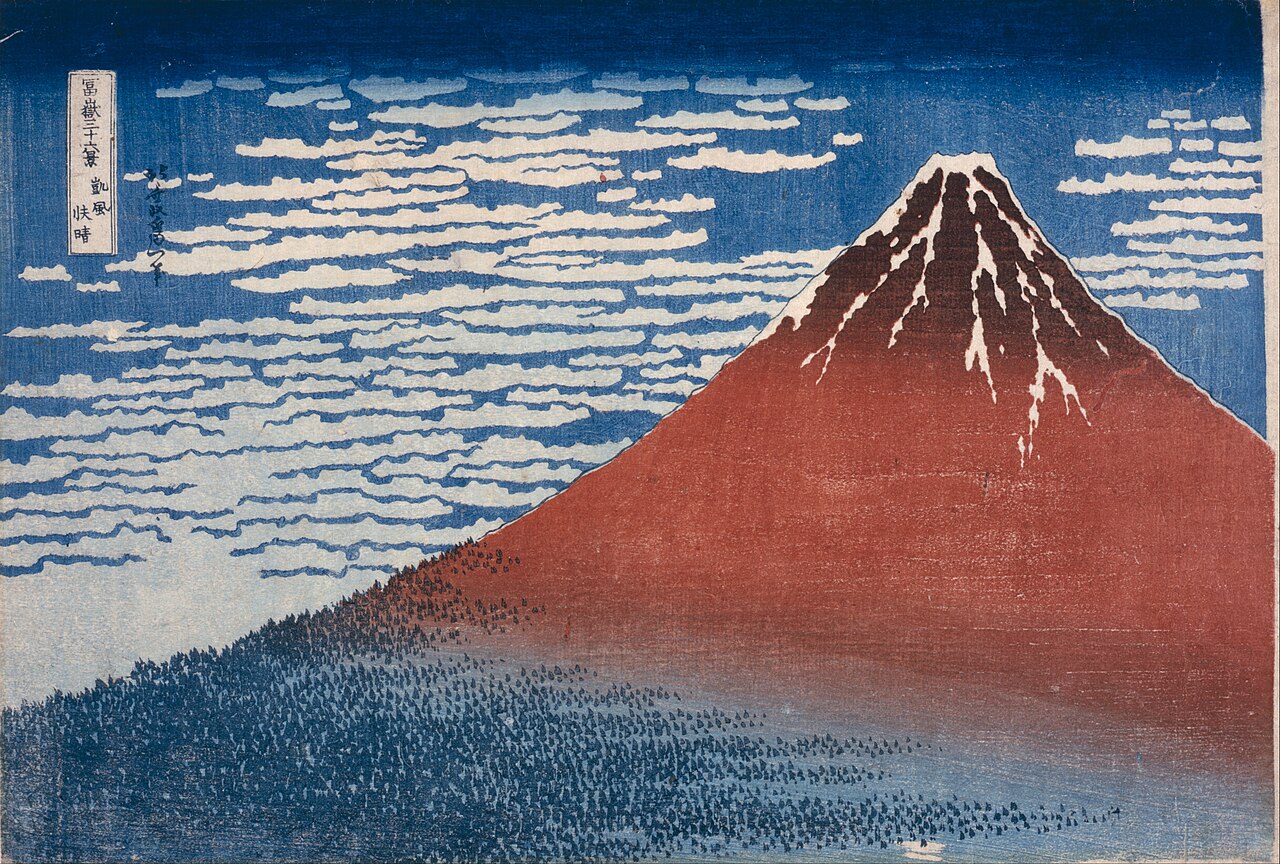
Source: Wikimedia Commons. Public domain.
Shinto, “The Way of the Gods”, holds that spirits, kami, exist in all natural phenomena. Segen-Sama, goddess of Mount Fuji, is the most venerated. Mount Fuji is the setting of many Japanese myths. It is believed, for example, to be the dwelling of Kunitokotachi, the Lord of Eternal Earth, an invisible, omnipresent creator deity who emerged in the form of a reed from the chaos of the primordial ocean.
Kaguya-hime
Long ago, an old man found a newborn girl on one of the slopes of Fuji. He named her Kaguya-hime. As she grew, the girl became a beautiful woman and married the Emperor. But after seven years of marriage, she told her husband that, as she was not mortal, she had to return to heaven. To console the Emperor, she gave him a mirror, telling him that in it he would always be able to see her.
The Emperor, longing to go to heaven with her, used the mirror to follow her to the summit of Fuji... but he could go no further. His heartbroken love caused him to set fire to the mirror, and from that day on, fire has always risen from the mountain’s peak.
Fuji vs. Haku
Mount Fuji (feminine) and its neighbor, Mount Haku (masculine), disputed which of the two was the tallest. To settle the matter, the Buddha of Infinite Light had a tube passed from the summit of Mount Haku to the summit of Mount Fuji. When the water was poured over the summit of Mount Fuji, the goddess became so angry that she struck Haku on the head and broke his skull into eight fragments (the eight current peaks of Mount Haku). As a result, Mount Fuji is today the higher of the two.